The search for reliable Amino Tryptophan suppliers in 2026 is about more than finding a competitive price. Buyers need material that performs consistently, arrives on schedule, and comes with documentation that stands up to review. Grand View Research’s amino acids market analysis projects a 7.6% compound annual growth rate from 2024 to 2030. That figure covers the broader amino acids category, not tryptophan alone. It signals momentum, but it cannot confirm any supplier’s quality.
Small details matter. A clear certificate of analysis should identify the assay method, purity, batch number, and relevant microbiological or contaminant results. Buyers should also check production capacity, traceability, packaging, shipping conditions, and how quickly a supplier responds when a specification changes. Certifications can help, but their scope and current validity need checking; a logo on a brochure is not proof of a specific batch’s quality. This comparison will assess suppliers against practical sourcing criteria rather than imply that one company suits every application. It will also distinguish verified company information from claims that need direct confirmation. That distinction is easy to overlook. Public supplier data can be incomplete, and availability may vary by region or contract. Readers should confirm specifications, documentation, and lead times directly before making a purchasing decision.
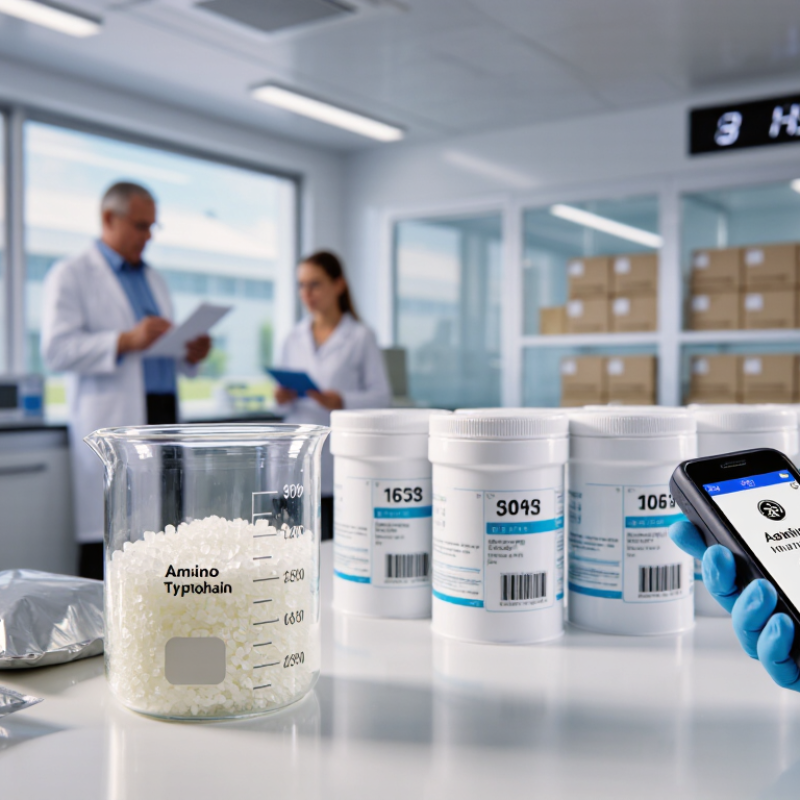
L-tryptophan is an essential amino acid, meaning the body cannot make enough of it. It must come from food or other sources. It helps build proteins and serves as a precursor to compounds such as serotonin and melatonin. Those roles do not make every product identical.
Commercial L-tryptophan is commonly made through microbial fermentation. Selected microorganisms use sugars and nutrients in carefully controlled tanks. Temperature, pH, oxygen, and fermentation time can all affect yield. Small shifts matter. After fermentation, the compound is separated from the liquid, purified, crystallized, and dried into powder or granules.
Quality testing can check identity, purity, moisture, and unwanted residues. A certificate of analysis provides batch-specific information, but buyers should also review testing methods and product traceability. The process sounds tidy on paper; real batches still need close monitoring. Fermentation conditions and purification choices can affect consistency, so supplier comparisons should consider documented quality controls, not just price or stated purity.
A strong amino tryptophan supplier is judged by evidence, not polished sales material. Ask for a recent certificate of analysis and compare its results with your specification. Check identity, assay, moisture, and relevant contaminant limits. The test methods should be named, and the testing laboratory should be qualified. Small details matter. A missing method or unclear unit can delay a quality review.
Reliability also shows in traceability and day-to-day communication. Request a sample lot record linking raw materials, production dates, and finished goods. Review how deviations are investigated and how corrective actions are documented. Ask about typical lead times, shipment conditions, and plans for unexpected shortages. A supplier that answers difficult questions clearly is often more dependable than one promising flawless service. Still, one helpful contact does not prove that every batch will meet expectations.
A practical evaluation includes a trial order and a documented review of the received lot. Compare the supplier’s paperwork with independent test results where appropriate, then record any mismatch. No scorecard is perfect. Some teams overvalue price or certificates and overlook slow change notifications. That is easy to miss. Reassess performance periodically, especially after process changes or delivery problems, and keep acceptance criteria consistent across suppliers. These checks support a reasoned choice without treating any supplier as automatically best.
This chart outlines one practical framework for assessing suppliers. The percentages are illustrative weights, not verified market data or supplier scores; no supplier ranking is implied.
In 2026, leading amino tryptophan suppliers will stand out through consistent documentation, dependable lot quality, and clear communication—not polished claims alone. Buyers should request a current certificate of analysis for each batch, with identity, assay, moisture, and contaminant results shown. Ask how samples are retained and how deviations are investigated. Good answers are specific.
Reliable suppliers also make traceability practical. Their records should connect raw-material sources, production dates, testing, and shipment codes. Check whether packaging protects the amino acid from humidity during storage and transit. Confirm lead times, minimum order quantities, and change-notification practices before placing repeat orders. Small details matter.
Supplier selection depends on the intended application and the buyer’s own quality system. Compare independent test data, facility controls, and responsiveness, then review a pilot lot before scaling. A low price can hide added testing or freight costs. No checklist is perfect. Some buyers still overlook the awkward question: what happens when a batch misses specification? A supplier’s written response plan may reveal more than its brochure.
Supplier names and brand rankings are omitted. The table compares supplier categories and practical checks; actual product specifications and certifications must be verified with each supplier’s current documentation.
| Supplier category | Typical product scope | Key information to verify | Best suited for |
|---|---|---|---|
| Fermentation-based manufacturer | L-tryptophan produced through microbial fermentation; food, feed, or other grades may be offered. | Manufacturing site, intended-use grade, certificate of analysis (CoA), test methods, batch traceability, and applicable certifications. | Buyers seeking direct manufacturing information and recurring bulk supply. |
| Specialty ingredient distributor | L-tryptophan sourced from one or more manufacturers, often supplied in regionally available pack sizes. | Original manufacturer and country of origin, storage conditions, lot-level CoA, stock status, and change-control process. | Buyers prioritizing local availability, smaller order quantities, or regional logistics. |
| Pharmaceutical or regulated-market supplier | Material offered for regulated applications where a defined quality system and documentation package are required. | Applicable pharmacopoeial or customer specifications, quality-system scope, impurity controls, audit support, and regulatory documentation. | Organizations with formal qualification, audit, and documentation requirements. |
| Nutrition-grade ingredient supplier | L-tryptophan intended for a specified food or supplement application, subject to local rules and product specifications. | Permitted intended use in the destination market, identity and purity testing, allergen and contaminant statements, and label-support documents. | Food and supplement manufacturers evaluating market-specific compliance. |
| Feed-grade amino acid supplier | L-tryptophan intended for animal-feed formulations, with specifications selected for the relevant feed use. | Feed-grade specification, assay basis, moisture and impurity limits, local registration requirements, and delivery consistency. | Feed manufacturers and nutrition formulators. |
| Laboratory and small-quantity supplier | Research or analytical quantities of L-tryptophan; these products are not automatically suitable for food, feed, or pharmaceutical use. | Declared grade, analytical methods, package size, safety data sheet, and explicit restrictions on intended use. | Research laboratories and method-development work. |
Product identity reference: L-tryptophan is an essential amino acid with molecular formula C11H12N2O2 and molar mass approximately 204.23 g/mol. Grade, assay limits, certifications, and regulatory suitability vary by product and market; confirm them against the current specification and batch-specific CoA.
Supplier comparisons should start with usable annual capacity, not headline plant size. Ask for tryptophan-specific output, recent utilization, batch size, and lead times. Grand View Research valued the broader global amino-acids market at USD 29.5 billion in 2023 and projected an 8.0% compound annual growth rate through 2030. This is useful market context, not proof of tryptophan capacity. A neat spreadsheet can still mislead: confirm figures with production records and recent shipment history.
Certification must match the intended application. Check current certificates, their scope, issuing bodies, and the exact manufacturing site; a company-wide certificate may not cover every facility or product. For food ingredients, ask about food-safety systems such as ISO 22000 or FSSC 22000, plus batch-level traceability and contaminant testing. For pharmaceutical applications, verify relevant GMP controls and required documentation rather than assuming a food-grade certificate is enough. Small details matter, like whether a certificate expires next month.
Tip: Compare reach through delivery evidence: destination markets served, export documents, packaging options, and on-time delivery rates. Ask for a recent certificate of analysis and a sample lot record. Grand View Research’s market forecast describes demand broadly; it does not rank individual suppliers. Treat supplier claims as starting points, then validate them against auditable documents and trial orders.
Amino tryptophan supplier selection should begin with verifiable records, not a polished catalog. Ask for a recent, lot-specific certificate of analysis and check that it identifies the material, test methods, results, and acceptance limits. Compare the stated identity and purity with your own product specifications. A certificate without clear methods leaves room for doubt.
Request supporting details on raw-material traceability, batch coding, storage conditions, and change notifications. Where independent testing matters, confirm the laboratory’s qualifications and whether its methods suit the material and intended use. Review relevant impurity, moisture, and microbiological data against your requirements; limits can vary by application. A tidy document is not the whole story. Ask how the supplier handles out-of-specification results and retains samples.
Small gaps matter. Before placing a large order, assess a representative sample and compare its test results with the documentation. Check whether the supplier can explain differences between batches without vague assurances. Responsiveness counts, but so does a clear quality agreement covering specifications, packaging, and complaint handling. One awkward point: buyers sometimes accept familiar paperwork too quickly. A short supplier audit or technical call can reveal whether the written process matches daily practice.