Top Types of Park Music Fountains for Global Buyers
A Park Music Fountain can turn an ordinary plaza into a shared destination. Yet the best choice is not always the tallest spray. Buyers must match the display to visitor flow, site conditions, maintenance capacity, and budget. Mark Fuller, founder of water-feature design company WET, offers a useful design perspective. The following line is an editorial paraphrase, not a verbatim quotation: “Let water, light, and movement serve the place—not overwhelm it.”
The main options include choreographed musical fountains, interactive play fountains, floating lake displays, and compact plaza systems. Each creates a different experience. Synchronized jets can rise with a soundtrack, while colored lights reflect across a shallow basin. Interactive nozzles invite children to run through brief bursts of water. Floating systems can cover broad ponds, though wind may scatter their patterns. Simple details matter. A wet stone edge, a visible service hatch, or a poorly aimed nozzle can change how visitors experience the entire site.
Global buyers should compare pump capacity, nozzle layouts, controls, lighting, sound coverage, and water-treatment needs. Ask how the system performs in local weather. Check whether technicians can access replacement parts and service equipment nearby. A dramatic show may attract crowds, but complex choreography can demand more upkeep than expected. That trade-off deserves honest attention. This guide introduces the leading Park Music Fountain types and explains where each may fit, from civic squares to resort gardens. No single design suits every park. The right choice balances spectacle with reliability, comfort, and practical care.
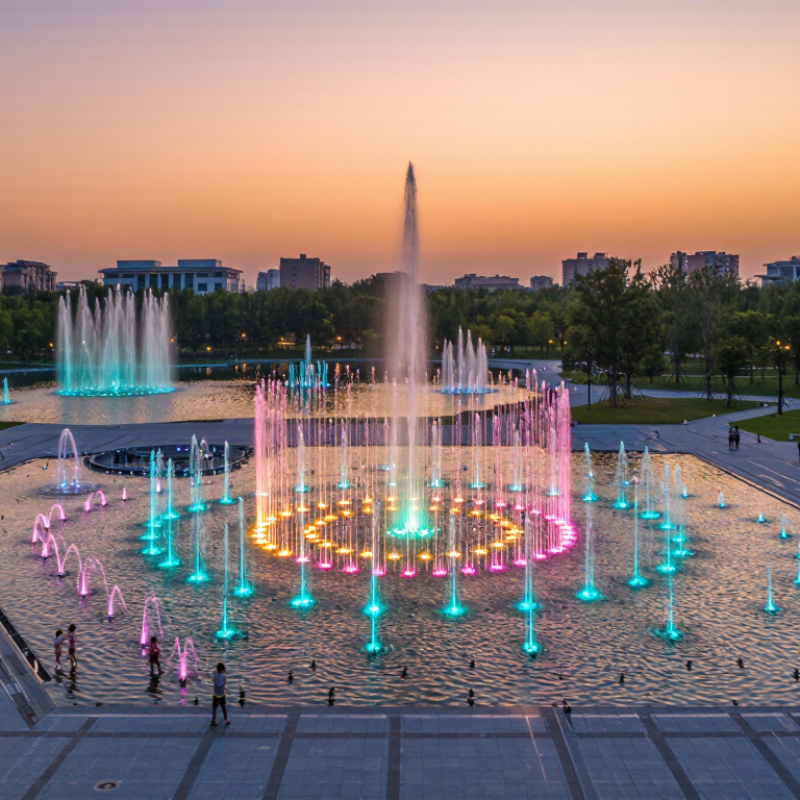
Classify Musical, Interactive, Floating, and Dry-Deck Fountain Systems
Musical fountains coordinate pumps, valves, and lighting with timed audio cues. They suit promenades and central plazas, where visitors can watch from a clear viewing edge. Interactive systems respond to buttons, sensors, or programmed zones. Check response time, slip-resistant paving, and accessible routes before selecting them. A splash feature needs active supervision. A useful distinction.
Floating fountains sit on platforms in ponds or reservoirs. Their spray height depends on water depth, wind, and pump capacity; a dramatic plume can drift onto paths. Confirm anchoring, maintenance access, and water-quality conditions during site planning.
Dry-deck systems place flush nozzles beneath paving, leaving the surface open when the jets are off. They fit civic squares and event spaces, but drainage must handle sudden runoff. The labels can mislead: a dry deck may still require substantial water management.
Water efficiency deserves attention across all four types. UNESCO’s United Nations World Water Development Report 2023 says global water use has risen by roughly 1% annually over the past four decades. The U.S. Environmental Protection Agency estimates outdoor water use exceeds 9 billion gallons per day, much of it for irrigation. These figures are not fountain-specific, but they support asking suppliers for recirculation rates, evaporation assumptions, and operating schedules. One overlooked detail: spray drift can waste water and wet nearby seating. Check it on site.
Compare Jet Height, Nozzle Layout, and Pump Capacity Across Site Scales
Park music fountains usually fall into compact plaza systems, medium park displays, and large lake installations. Their scale changes more than appearance. A six-meter jet can feel dramatic in a small pool, while the same height may disappear against a broad waterfront. Wind matters. Tall jets can drift, so designers should check local exposure before setting target height.
For compact sites, a ring or clustered nozzle layout creates a clear focal point with modest water demand. Medium parks often use several arcs or straight rows, giving operators more options for matching musical cues. Large basins can support wider patterns, but long pipe runs add friction and complicate pressure balance. Not every nozzle needs to run at once. That detail is easy to overlook.
Pump capacity should be assessed at the required flow and operating head, not by motor size alone. Ask for performance data that accounts for pipe length, fittings, filters, and the number of active jets. A small site may need fewer pumps, while a broad display may use separate zones for flexible sequencing and maintenance. Keep access practical. A beautifully dense layout can become awkward to clean. I would also leave room for adjustment; early estimates rarely capture every site condition.
Specify Submersible Lighting by IEC 60529 IP68 Ingress-Protection Rating
For park music fountains, underwater lights face more than splashes. They may sit beneath several metres of water, near moving jets and vibrating pipework. IEC 60529 IP68 indicates protection against dust and immersion, but “8” does not set one universal depth or duration. Check the fixture documentation for its stated immersion conditions. Specify the complete luminaire, cable entry, and supplied connection—not just the housing.
A high IP rating does not automatically mean a light suits every fountain. Confirm that seals remain accessible for inspection and that cables are rated for permanent underwater use. Ask how the unit handles water temperature, cleaning chemicals, and expected maintenance. These details matter when a fixture is installed beneath a stone basin and difficult to reach. I would not treat IP68 alone as proof of long service life; installation quality still counts.
Tips: Request the IEC 60529 test details, including immersion depth and time. Inspect cable glands before commissioning, and record the installation date. Small gaps can become expensive problems.
Plan Sound-Level Checks with IEC 61672 Meters and dB(A) Measurements
Top Types of Park Music Fountains for Global Buyers
Plan Sound-Level Checks with IEC 61672 Meters and dB(A) Measurements
When comparing park music fountains, sound quality is only part of the decision. Ask how the supplier measures sound during a complete operating cycle. Use a sound level meter that conforms to IEC 61672, and record A-weighted readings in dB(A). This weighting broadly reflects human hearing, but it does not describe every aspect of sound.
Measure at realistic listener locations, such as a nearby bench and the edge of a seating area. Note the fountain’s music setting, distance, weather, and surrounding activity. Record LAeq over a defined period, rather than relying on one instant reading. Check the meter with an acoustic calibrator before and after testing; this field check does not replace scheduled instrument calibration. Reflections from paving or nearby walls can change results. Measurements also vary with wind and crowd noise, so repeat them under comparable conditions. One imperfect detail: a quiet test site may not represent a busy summer afternoon.
Tips: Keep the microphone at ear height, use a windscreen outdoors, and log background sound with the music off. Compare readings carefully; local limits and assessment methods can differ.
Verify Electrical Compatibility with IEC 60364 and 50/60 Hz Supplies
Park music fountains combine pumps, underwater lighting, control panels, and audio equipment, so electrical checks should begin before the basin is built. IEC 60364 provides a framework for low-voltage installations, but buyers should confirm which edition and national adoption apply at the project site. A qualified electrical professional can review earthing, protective devices, cable sizing, isolation, and equipment locations around wet areas. Small details matter.
Check both supply voltage and frequency on every pump, light driver, and controller. A 50 Hz motor may not operate as intended on a 60 Hz supply, or vice versa; speed, load, and heat can change. Some equipment accepts both frequencies, but the label or technical documentation must say so. A frequency converter is not an automatic fix. It must suit the motor and control system.
Ask suppliers for nameplate data, wiring diagrams, and written confirmation of operating limits. Then compare those details with the site’s measured supply and the installation design. A common planning miss is checking the pumps but overlooking lighting drivers or control cabinets. That can delay commissioning. Even tidy specifications can leave gaps, so record assumptions and resolve them before purchase. Verify the final installation against local requirements, not a brochure alone.
Park Music Fountains: Nominal Mains Frequency by Sample Market
Check the fountain’s rated input against the site’s local electrical supply before selecting pumps, lighting, and control equipment.
Values show nominal grid frequency, not product compatibility or approval. Japan has 50 Hz service in the east and 60 Hz in the west. Confirm the actual site supply, voltage, phase, earthing, and protective measures with the equipment manufacturer and a qualified local electrical professional. IEC 60364 addresses low-voltage electrical installations; applicable national rules and local requirements must also be checked.


